


First development of the year for Commodore 64
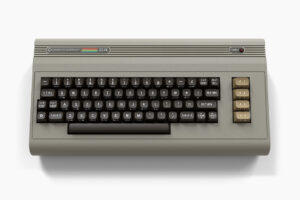
This would be my fourth game developed using the AGPX Basic to Assembler transpiler, so little by little, with each game, I’m evolving in the depth I want to give my games on the platform. By the way, let’s not forget that the Commodore 64 is an 8-bit microcomputer running at 1 MHz, with 64 KB of RAM, 8 hardware sprites that can be expanded with multiplexing, and a 16-color palette that has a catch: the sprites and multicolored characters can only have 4 colors—1 background, 1 of their own, and 2 shared among all the sprites. The same applies to the characters, which have the same limitation, and the design magic here lies in carefully selecting the shared colors and not repeating them among the sprites and characters that make up the stages to give the game a more than acceptable color palette.
Without being a graphic artist, I’ve had to work very hard on this, in addition to programming the games. My friend Adrián Bonnette has helped me by painting the backgrounds for the last four games and some sprites, and I’ve taken on the task of drawing characters and enemies in the games to give them as much color as possible within the limited 16-color palette. This palette, by the way, is heavily criticized in Europe because the colors on PAL systems look a bit washed out compared to their NTSC counterparts, where, in my opinion, they shine as Commodore Business Machines intended them to in the early 80s.
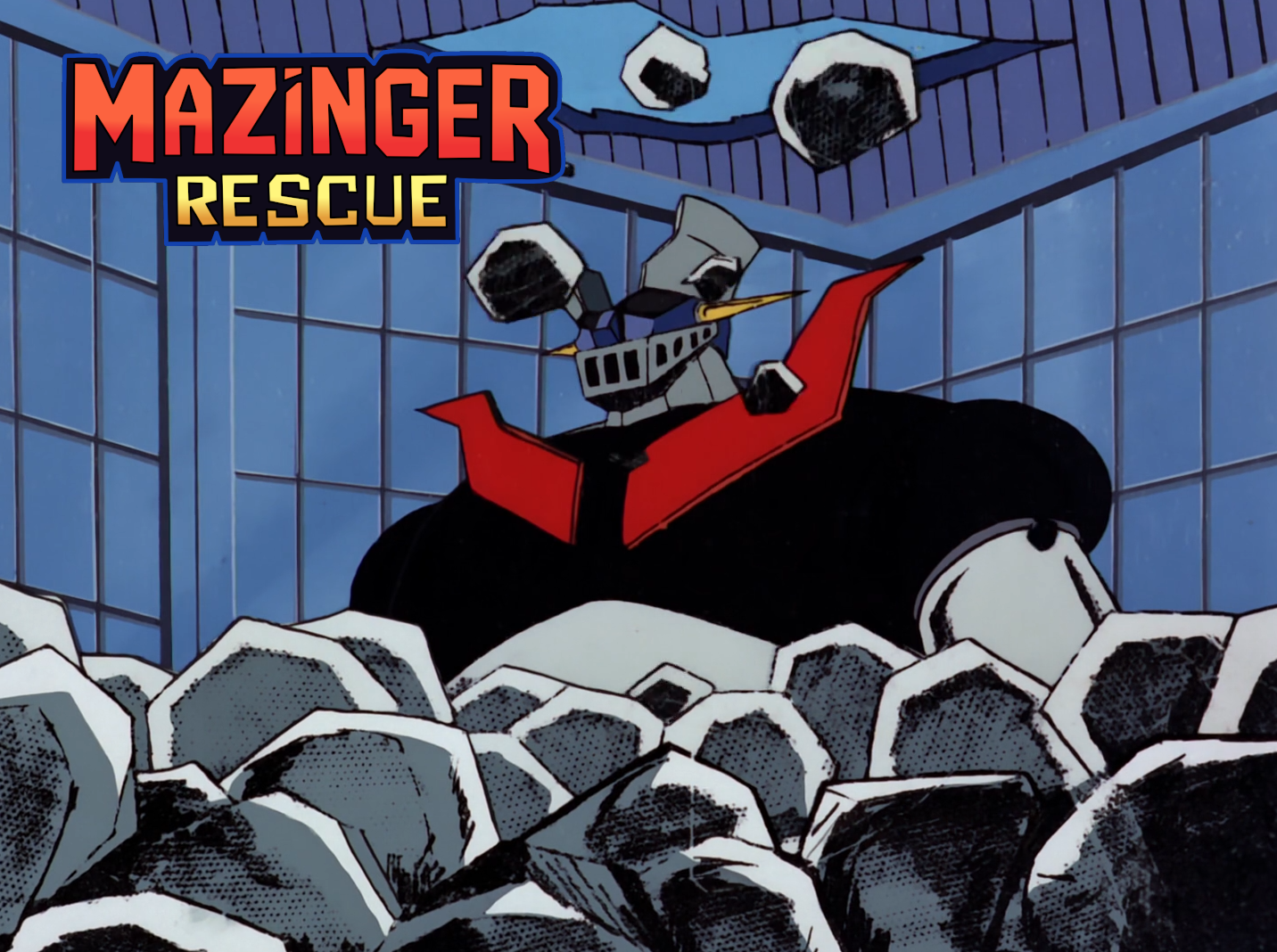
Now, let’s talk about the game. Mazinger Rescue features high-definition graphics, or to put it more simply, the sprites are high-definition because the C64 has a resolution of 320×200 (high definition for the 80s), and its multi-colored sprites are pixelated, which creates a low-resolution feel. Alternatively, you can use high-definition, single-color sprites with better definition. Combining high-resolution sprites with low-resolution sprites generates a high-resolution sprite with more colors, but with the drawback of consuming more sprites than your initial 8. For example, you can develop a character with a 24×21 black outline and place a 12×21 multicolored sprite underneath to fill the colored gaps, creating a beautiful character, but one that uses 2 sprites. This is where sprite multiplexing comes into play, allowing you to generate more sprites with the limitation that no more than 8 can be in the same horizontal line, and the merciless memory consumption.
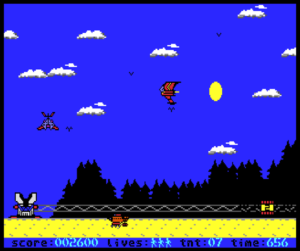
In this game, I use these techniques to give a more polished graphical appearance, and I carefully control the number of enemies on screen so that the FPS doesn’t drop abruptly or the game doesn’t simply crash.
The game features four wonderful chip tunes based on themes from the original series, arranged by the amazing Spanish musician Narciso Quintana, who has made a name for himself in the global Commodore music scene. Thank you, maestro!
On the other hand, Mazinger Rescue is inspired by the Minit Man game, which I loved in the ’80s. In that game, you pilot a helicopter with little men and navigate three levels, completing a bridge to allow a supply train to pass. In my game, which is much easier, you carry dynamite to blow up a structure that’s trapping Mazinger Z with a neutron bomb that will explode in 12 minutes, ending the super robot’s reign.
I hope you enjoy my latest creation, and please read the instructions on its iTchio page so you can enjoy the adventure I’m giving you for your 8-bit weekends!
Congratulations, KabutoCoder! In my opinion, this is your best Mazinger game yet. This new release pushes your skills to the limit, and piloting the Pilder through the enemies is incredibly rewarding.
Plus, the gameplay mechanic of using TNT to free Mazinger from his iron prison adds a really interesting twist.
Thank you so much for sharing it with our community.
Thanks, Pedro, for your kind words!
And yes, I feel this is my best production so far. Let’s see how the next one goes; I’ll put a lot of effort into it!